
The estimate is booked, but the homeowner has changed which building they want you to look at. Does your estimator have the new note, or just the original calendar entry? A useful roofing lead handoff gives the estimator the current request, keeps the unanswered questions visible and records that the update reached the person attending.
Use one shared record for the appointment. Keep its history, name the current version and make later changes easy to find. This is a suggested handoff method for roofing business owners, not a claim about a provider's installed software or results.
Start the roofing lead handoff after the fit check
Qualification asks whether the request fits the work your business handles and what needs clarifying before a booking. The handoff asks a different question: does the person attending have the latest information?
Use the roofing lead qualification checklist for the earlier fit decision. Once a visit is agreed, carry its record forward rather than creating an unrelated summary that loses the source notes.
Keep the appointment ID, agreed time and time zone beside the requested work. Name the estimator receiving it. A calendar entry establishes the planned visit; it does not establish that the estimator has read a changed request.
Send a current note with a visible history
Give the estimator a short summary that points back to the full record. Label the summary with its update time. Keep the earlier description available and mark what changed instead of silently replacing it.
| Handoff field | What the estimator should be able to find |
|---|---|
| Appointment reference | The same visit ID used in the calendar and inquiry record |
| Current request | The latest homeowner description, with its source and time |
| Visit purpose | What the appointment was arranged to discuss |
| Open questions | What still needs checking, without guesses presented as facts |
| Latest change | What changed since the appointment was arranged |
| Receiving person | Who is attending and where the current note was sent |
| Receipt | Whether that person confirmed receiving this version |
Keep the difference between receipt and agreement clear. An estimator can receive a note and still need to review whether the changed request fits the visit. Record those as separate checks.
Do not add a diagnosis, repair method or price to make the handoff look complete. Keep the homeowner's words as their description. The contractor decides what assessment and work are appropriate.
Worked example: the request changes after booking
This is a fictional example, not a customer story or a ServiceConsulting result. All times are Eastern Time.
Visit EXAMPLE-R1 is arranged for Wednesday at 2:00pm. The original request says “estimate for the house roof.” On Tuesday morning, the homeowner clarifies that they mean a detached garage at the same address.
| Time | Record update | Handoff action |
|---|---|---|
| Monday, 3:00pm | Visit arranged; original house-roof description retained | Send the original request with the visit reference |
| Tuesday, 9:15am | Homeowner says the requested estimate is for the detached garage | Add the clarification; mark the house-roof description as superseded |
| Tuesday, 9:20am | Updated summary sent to the assigned estimator | Label it with the update time; receipt still unconfirmed |
| Tuesday, 10:00am | Estimator confirms receiving the garage clarification | Record receipt; scope review and any booking change remain separate decisions |
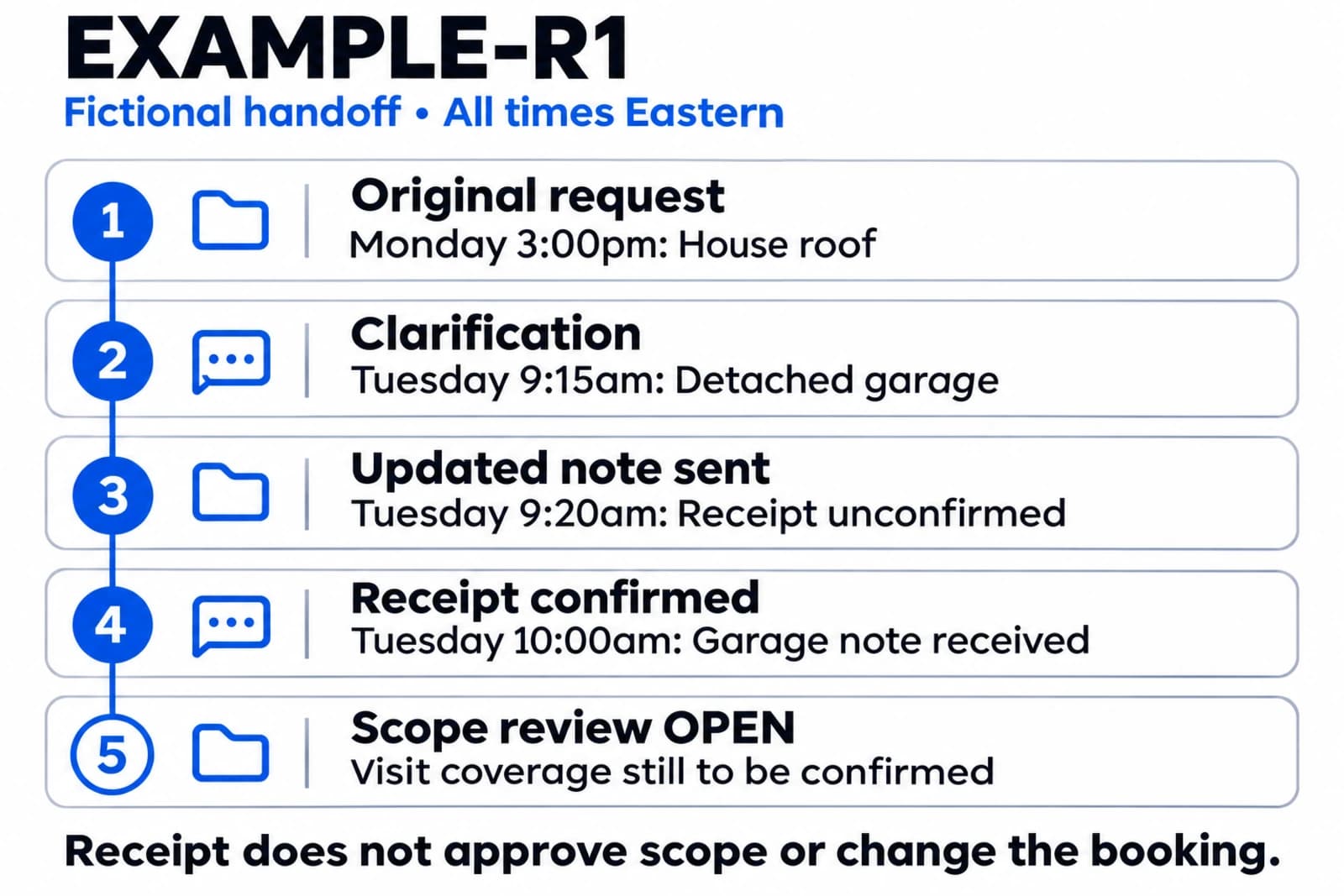
The updated handoff should say what is still open. For example: “Garage request received. Estimator to confirm whether the visit can cover it. Existing appointment time has not been changed.” Do not describe the new scope as accepted just because the message arrived.
If the estimator decides a different visit is needed, record the proposed change and who will confirm it with the homeowner. Keep the existing booking state accurate until that conversation happens. Neither the homeowner's clarification nor the estimator's receipt alone confirms a new appointment.
Close the handoff when the person attending has it
Sending a note and confirming receipt are different events. Record where the update went and when the receiving person confirmed it. If receipt is still unknown, leave it unknown and name the person checking it.
When a different estimator takes the visit, pass along the current record and ask that person to confirm receipt. The previous estimator's acknowledgement does not establish that the replacement has the information.
Keep the handoff in the business system your team uses for the appointment. Avoid scattering separate copies across messages without a clear current version. A short message can point to the record and identify the specific change the estimator needs to read.
Keep the handoff separate from the visit outcome
An accepted handoff is not proof that the visit happened. After the appointment, record attendance and later updates against the same visit reference. The contractor lead reporting guide explains how to keep those events separate without counting a changed time as a new inquiry.
For your next roofing lead handoff, check one booked visit: identify the latest request, name the person attending and confirm that they received the current note. Leave any unresolved scope or scheduling decision visible beside it.