
Check a paver inquiry against your actual service area, the estimator's travel plan and an available appointment window before agreeing to a visit. A location that your business serves still needs a workable place in the calendar. When an address or access detail is missing, keep the decision open and name the person who will resolve it.
For a paver contractor, this is a practical scheduling question: can the right person get to this property for the requested conversation? Start with that decision before treating an inquiry as an estimate ready to book.
Separate the work question from the location question
First establish what the homeowner wants. A new patio, a change to existing paving and a request to clean or seal an existing surface call for different conversations. Use the guide to separate installation from sealing requests when the work itself is unclear.
Then evaluate location separately. A suitable project can be outside the area your team covers. An address inside your area can still involve work your business does not take on. Put those decisions in separate fields so that a positive answer to one does not silently answer the other.
Use your business's current rules for the requested work. Do not turn the nearest town name, a broad ZIP code or a homeowner's description of being “just down the road” into a confirmed service-area decision.
Check paver lead service areas against an actual address
Record the property address supplied for the estimate. If the contact gives only a neighborhood or sends a map pin without identifying the property, ask for the missing detail before making a coverage decision.
Keep the source with the answer. “Address supplied by homeowner” and “address checked against our coverage rules by the scheduler” describe different steps. Record both when both have happened.
Your coverage rule might use a list of locations, a boundary on a map or another method your business has chosen. Apply that rule consistently. If the request sits near a boundary, route the decision to the person who owns coverage instead of inventing an exception during the conversation.
Write down the result as one of three states:
- Within current coverage: the address has been checked against the rule for that work.
- Needs clarification: a missing fact or an unresolved exception prevents the decision.
- Outside current coverage: the checked address does not fit the rule being applied.
“Needs clarification” is a real next step. It should not be silently converted into either a rejection or an agreement to visit.
Fit the trip into the estimator's day
After the location check, look at the actual calendar. Identify who could attend, where that person would be coming from and what commitment follows the proposed visit. Ask the operator responsible for scheduling to choose the travel allowance and visit window.
Do not use an empty rectangle in the calendar as the whole answer. Check whether that time also allows the estimator to reach the property and continue to the next commitment. If the calendar cannot support the homeowner's preferred time, keep it as a preference while another window is discussed.
Keep estimate availability separate from installation availability. Agreeing to discuss a project at the property should not imply a crew start date. Record any request about installation timing for the appropriate person to answer separately.
Access can also need clarification before a visit is arranged. Ask how the estimator will reach the area the homeowner wants to discuss and who will provide any needed access. Record the answer without inferring that an inspection or a particular piece of work can be completed during the visit.
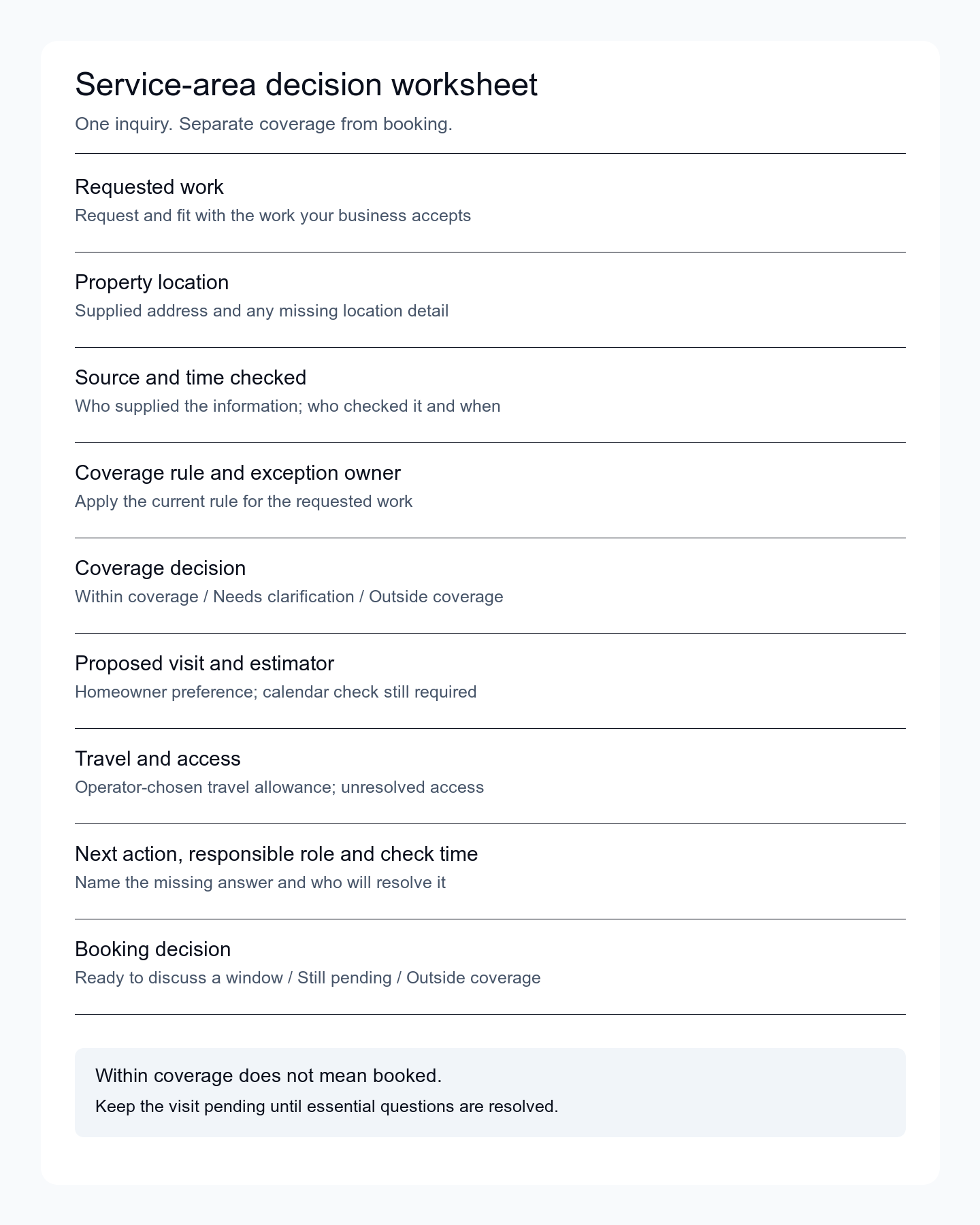
Use a service-area decision worksheet
Create one record per inquiry. Fill it with the facts your team has, and leave the decision pending where an essential answer is still missing.
| Field | What to record |
|---|---|
| Requested work | The homeowner's request and whether it matches the work your business accepts |
| Property location | The supplied address and any detail still needed to identify the property |
| Source and time checked | Who supplied the information and when your team checked it |
| Coverage rule | The current rule used and the person responsible for exceptions |
| Coverage decision | Within coverage, needs clarification or outside coverage |
| Proposed visit | Homeowner preference, potential estimator and calendar check still required |
| Travel and access | Operator-chosen travel allowance and any unresolved access arrangements |
| Next action | The missing answer, the role responsible and when it will be checked |
| Booking decision | Ready to discuss a specific window, still pending or outside current coverage |
Keep the coverage decision and booking decision separate. “Within coverage; calendar check pending” is more useful than one green tick that could mean either.
Walk through an inquiry with an unresolved address
Imagine a homeowner asks about sealing an existing patio and gives a neighborhood name. They prefer an afternoon visit. Your scheduler recognizes the neighborhood, but has not received the property address or checked the estimator's route.
The initial record would read:
| Check | Current note | Next action |
|---|---|---|
| Work | Homeowner asks about sealing existing paving | Compare the request with the business's accepted work |
| Location | Neighborhood supplied; property address missing | Scheduler asks the homeowner for the address |
| Coverage | Not yet checked | Coverage owner applies the current rule once the address is supplied |
| Time | Afternoon preference only | Scheduler checks an estimator's calendar and travel before offering a window |
| Booking | Pending | Do not present the preference as an agreed visit |
Now imagine the address arrives and the coverage owner confirms it fits the business's current rule. Update that field with the source of the decision. Leave the time field pending until the calendar and travel checks are complete.
If the preferred afternoon cannot accommodate the trip, discuss another window. The address has not become unsuitable merely because one time does not work. If the address falls outside coverage instead, record that reason and avoid offering a window on the assumption that someone else will approve an exception later.
This record lets the next person distinguish what changed from what remains unanswered.
Resolve service-area fit before agreeing to the visit
Use the worksheet on the next paver inquiry your team reviews. Confirm the location, apply your coverage rule and reconcile the trip with the estimator's calendar. Assign any open question before moving to a specific appointment window.
If you are evaluating an appointment service alongside your own intake process, read the paver appointment scope and the appointment process. Bring your actual coverage rules and available estimate windows to that discussion so the service-area question can be answered against your business's requirements.