
Evaluate painting lead results by checking what was counted, over which period and for which kind of painting work. Then ask what records support the claimed outcome. A case study can describe an observed result without establishing that your business will get the same result.
Use the questions below to assess the evidence behind a provider's claim before treating it as a reason to buy.
Define the result before comparing it
Start with the exact wording of the claim. Does “results” mean inquiries, appointments booked, estimates attended, quotes accepted or money collected? Those are different events. Do not replace one with another because both appear in the same presentation.
If a provider reports “estimates,” ask whether that means a scheduled visit, an attended visit or a written price proposal. Record the answer next to the number. For a separate explanation of the purchase unit, read the guide to pay-per-appointment lead generation.
When a percentage appears, ask for both counts used to calculate it. A close rate needs a stated denominator: all inquiries, attended estimates and submitted quotes describe different comparisons. Keep the original definition instead of converting it silently.
Check the period and painting project mix
Record the dates covered by the example. Ask whether the outcome belongs to inquiries received in that period or to jobs completed in that period. Those groups may overlap without being identical.
Then identify the work represented. An example covering interior repainting is not automatically evidence about an exterior painting campaign. Record the project category, service area and any limits disclosed by the provider. Missing detail is an unanswered question, not permission to invent a match.
You do not need a copy of another contractor's customer list. Ask for a summary or appropriately redacted records that explain the calculation without exposing homeowner contact details. The decision you need to make is whether the evidence supports the stated claim and is relevant enough to your own situation.
Use this painting lead results evidence checklist
| Question | What belongs in your notes |
|---|---|
| What is the exact claim? | The provider's wording, without strengthening it |
| What event was counted? | Inquiry, booking, attendance, accepted quote or collected payment |
| What period is covered? | Start and end dates, plus the rule for including a record |
| What is the comparison? | Both counts behind a rate, or the stated baseline |
| What painting work is included? | Project categories and any exclusions |
| Where did the inquiries originate? | The documented source, with unknowns retained |
| What supports the outcome? | The type of record and whether you actually reviewed it |
| What remains unresolved? | A specific question, owner and next step |
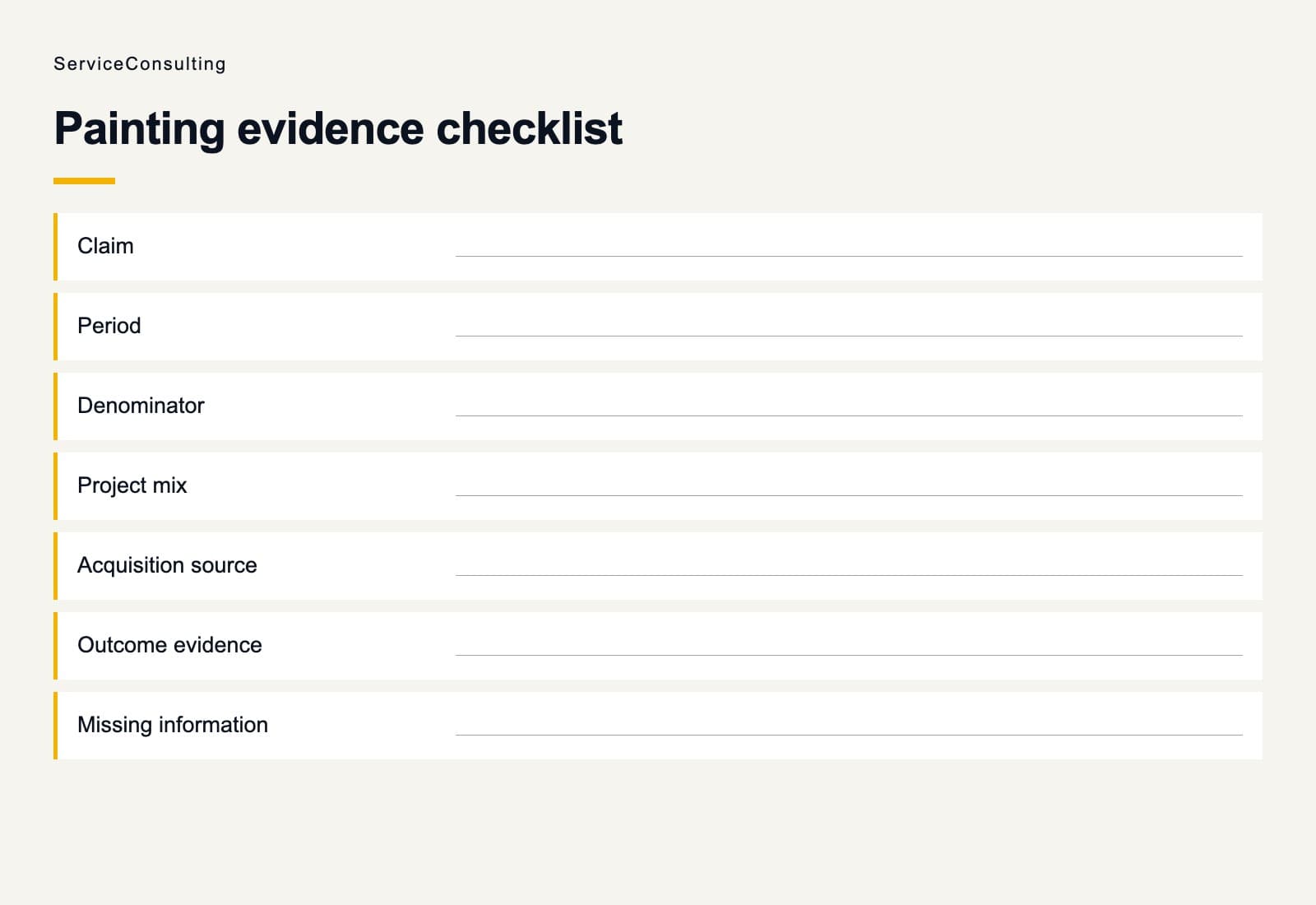
Separate “provider states” from “record reviewed.” A screenshot of a total may show the number being reported while leaving its definition or underlying records unexplained. Ask the missing question before calling the entire claim verified.
Complete the evidence review before comparing providers
Start with a blank record for each provider. Use these procedural questions to decide whether the claims can be compared:
| Review question | Your findings |
|---|---|
| Are the reported events defined the same way? | |
| Do the reporting periods and inclusion rules match? | |
| Is the painting project mix relevant to your work? | |
| Is the acquisition source documented? | |
| Can you connect the claimed outcome to supporting records? | |
| What information must the provider supply before comparison? |
Leave the findings blank until you receive the relevant information. Distinguish an unanswered question from evidence you have reviewed.
When definitions or periods differ, record the mismatch and ask the provider to clarify it. Compare only the stages and periods the evidence supports. If the provider cannot supply the missing detail, retain that gap in your decision notes.
Separate observed outcomes from attribution
A job recorded after a campaign does not, by timing alone, establish that the campaign produced it. Ask how the inquiry was connected to its source and how the eventual job was connected to that inquiry.
If the same customer had several contacts with the business, ask which attribution rule the report used. Keep repeat customers and unresolved sources visible in the explanation. Do not turn an unknown source into a campaign result to complete a spreadsheet.
An observed case study also leaves your own operating conditions to assess. Your requested work, service area, estimate availability and sales process need their own discussion. None becomes equivalent merely because the trade label matches.
Turn the evidence into a useful buying conversation
Bring the completed checklist and its unanswered questions to the provider. Ask which claims the evidence supports, which remain assumptions and what would be measured in your own arrangement.
For a conversation with ServiceConsulting, start with the painting appointment page and describe the work and estimate availability your team can support. Keep the buying decision grounded in defined responsibilities and evidence, rather than expecting another company's example to repeat itself.
The next step is to evaluate one painting lead results claim with the worksheet. Resolve the measurement unit first; then decide whether the supporting evidence is relevant to your business.