
Before buying HVAC replacement leads, ask the provider how it confirms that the homeowner wants a replacement or installation estimate. Request the actual qualification question, the recorded answer and the rule for handling repair requests or unclear intent. The phrase “HVAC lead” does not answer those questions.
If your business runs service calls as well as replacement estimates, you already have different work to schedule. Evaluate a provider against the work you want it to supply, rather than treating every heating or cooling inquiry as the same opportunity.
What counts as an HVAC replacement lead?
For your provider comparison, distinguish a homeowner asking about a new system from one asking to get an existing system working again. Also keep a category for people who have not decided which conversation they need.
Use these working distinctions when questioning the provider:
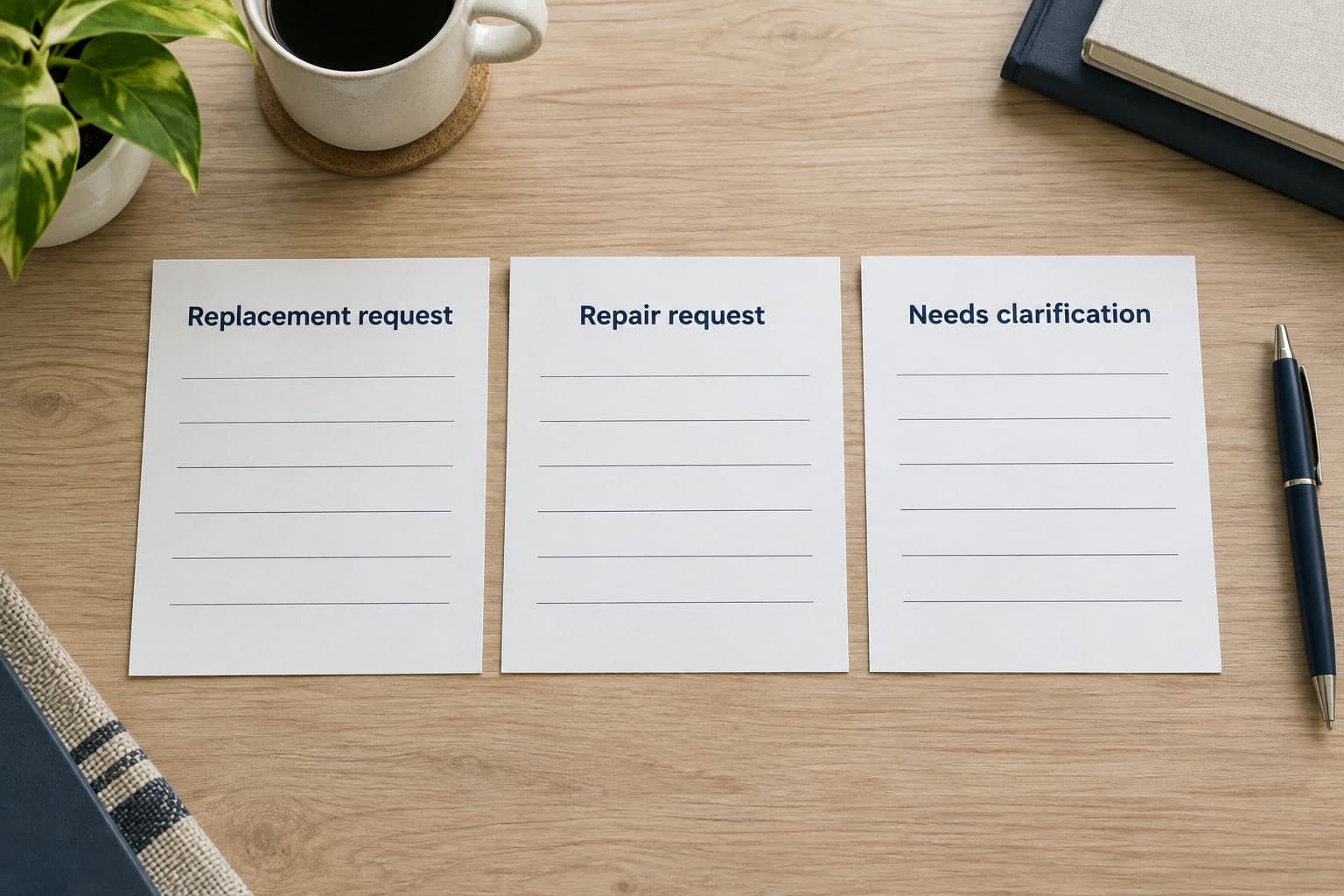
- Replacement or installation request: The homeowner asks to discuss or price a new system. Record what they actually requested.
- Service or repair request: The homeowner wants an existing system checked or repaired. Do not assume they have asked to buy a replacement.
- Unclear request: The inquiry describes a problem but does not establish the next step the homeowner wants.
These are evaluation categories, not technical diagnoses. A replacement request does not prove which equipment is appropriate, and a repair request should not be relabeled simply because a replacement could eventually be discussed.
ServiceConsulting's HVAC appointment scope focuses on replacement and installation estimates; service and repair calls are outside that scope. Check any provider's written scope against the part of your business you want to grow.
Ask to see the question behind the label
“We send qualified leads” leaves an important gap: qualified for what?
Ask the provider to show you the wording a homeowner sees and the follow-up that establishes the requested work. A generic heating-and-cooling form and an explicit request for a new-system estimate do not provide the same information.
Useful questions include:
- Does the form ask about replacement, installation, service or repair?
- Can the homeowner explain the request in their own words?
- If the answer is unclear, who clarifies it before delivery or booking?
- Will my team receive the original request and the clarification, or only a category label?
Ask for an anonymized example showing how those details travel with an inquiry. The example should explain the process without exposing a customer's personal information. It is not, by itself, evidence of the provider's overall project mix or results.
Check what happens to repair and unclear requests
Ask the provider to walk through this hypothetical situation: a homeowner says the system has stopped working but does not ask for a replacement estimate.
What happens next? Does someone clarify what the homeowner wants? Is the request routed to a service conversation, kept out of the replacement category, or delivered with its uncertainty visible?
The important point is the handling rule. You should be able to explain why that inquiry would or would not enter your replacement-estimate calendar. If the provider cannot explain, record the unanswered question before deciding.
Also ask how a mismatch is reported after delivery, which record is reviewed and what the applicable agreement says about resolution. Do not assume that your definition of a mismatch automatically creates a credit or other entitlement.
Keep equipment assessment with the contractor
Ask what technical promises, if any, are made before your team speaks with the homeowner. The provider should be able to show the wording rather than relying on a summary such as “we explain everything.”
Equipment age, a symptom or a form answer should not be treated as the provider's technical approval for a particular installation. For example, ENERGY STAR's ductless heating and cooling guidance describes contractor assessment of proper sizing using Manual J. That guidance concerns ductless systems; it is not a lead-qualification rule for every HVAC project.
For the provider conversation, the useful boundary is simple: establish what the homeowner requested and leave equipment selection and technical assessment to the appropriate HVAC professional. Do not count an inquiry as a committed installation just because it concerns a new system.
Use a provider comparison worksheet
Create one record for each provider. For every question, save the answer, the supporting document or example, the unresolved detail and the next action.
Project definition
Ask: “What homeowner request qualifies for your replacement or installation category?”
Evidence to request: the actual form or qualification wording and the written service scope. Note whether a repair-only or unclear request is excluded, clarified or handled separately.
Information delivered
Ask: “What will my team know before speaking with or visiting the homeowner?”
Evidence to request: an anonymized inquiry record showing the requested work, location, contact role and requested timing. Mark missing fields instead of assuming they will appear later.
Booking expectations
Ask: “What is the homeowner told the appointment is for, and who agrees the time?”
Evidence to request: the booking and confirmation wording. Check that your estimator and the homeowner are expecting the same kind of visit. The ServiceConsulting appointment process provides the service's booking overview.
Exceptions and resolution
Ask: “What happens if a delivered replacement inquiry turns out to be a repair-only request?”
Evidence to request: the written reporting and resolution terms. Record who reviews the original request and what your team needs to supply. Keep verbal assurances separate from the agreement.
Decide from the records, not the category name
Before choosing a provider, you should be able to answer three things in plain language: what request it accepts, what evidence reaches your team and what happens when the request does not fit.
If one answer is missing, make that your next provider question. HVAC replacement leads are useful to evaluate only when “replacement” has a clear meaning in the actual intake and delivery process. Start with the worksheet, resolve the gaps and then decide whether the service fits your replacement side of the business.